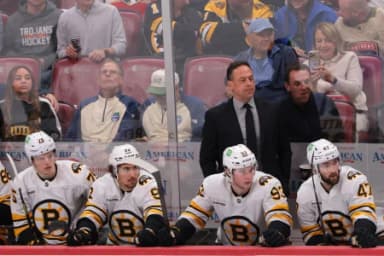

David Pastrnak and Marco Sturm aren't dealing with a star exit story yet. They're dealing with a Boston top six that still dries up too often at 5-on-5.
That's why the real question around Pastrnak isn't whether he's leaving the Bruins today.
It's whether Boston can give its franchise winger enough support to make the long-term fit feel as strong in March as it did when he signed through 2030-31.
Pastrnak has done his part on the surface.
He sits at 26 goals and 81 points in 62 games, while averaging 20:34 a night, which is still top-driver usage on a roster that leans on him every game.
The problem is what Boston.com pointed to last week: the Bruins' top forwards haven't produced enough at 5-on-5, and Sturm has already been pushed toward lineup reshuffles because of it.
That's where tension starts. If Pastrnak is your engine, but too much of the even-strength creation dies before it gets inside the dots, every shift starts to look like he has to solve the entire possession on his own.
Boston's overall spot makes that pressure louder. The Bruins were 36-22-6 on March 13, still in the playoff race, but doing it with structure and discipline more than pure offensive firepower.
The support around Pastrnak tells the story too. Morgan Geekie had 34 goals and 57 points in 64 games, Pavel Zacha had 45 points in 62, and Elias Lindholm had 40 in 52. Solid numbers, but not enough to erase long 5-on-5 lulls from the top six.
Why this matters more than a rumor
There's no clean evidence that Pastrnak wants out. His contract carries an $11.25 million cap hit, and Boston's own roster build still runs through him.
But stars notice when the burden gets repetitive.
Boston's own site led with Pastrnak scoring twice in an overtime loss to New Jersey on March 16, another reminder that big nights from him don't always fix the larger issue.
Sturm's value right now is that he isn't ducking the problem. NHL.com's reporting on his first season stressed his directness, his structure, and the way veterans have responded to his honesty behind the bench.
That makes the next step obvious. Boston needs a true 5-on-5 answer around Pastrnak, whether that means a different center look, more pace in the top six, or a harder split of the scoring load.
If that shift comes, the leaving talk stays where it belongs: outside noise. If it doesn't, every dry stretch around David Pastrnak is going to sound louder in Boston.
Are the Bruins giving David Pastrnak enough 5-on-5 help?
Voting closed